Kubernetes DevSecOps – End-to-End Security from Code to Runtime
Project Overview
Complete DevSecOps implementation spanning application code, container images, infrastructure, Kubernetes policies, runtime detection, and dynamic application testing.
This project demonstrates security controls integrated throughout the software delivery lifecycle rather than treated as a final security check.
The implementation uses OTel Labs as the instrumented application and OTel Labs Platform for infrastructure, Kubernetes, CI/CD, and security controls.
Builds on the OTel on EKS infrastructure foundation.
Security Layers
Security is implemented across seven distinct layers:
Architecture
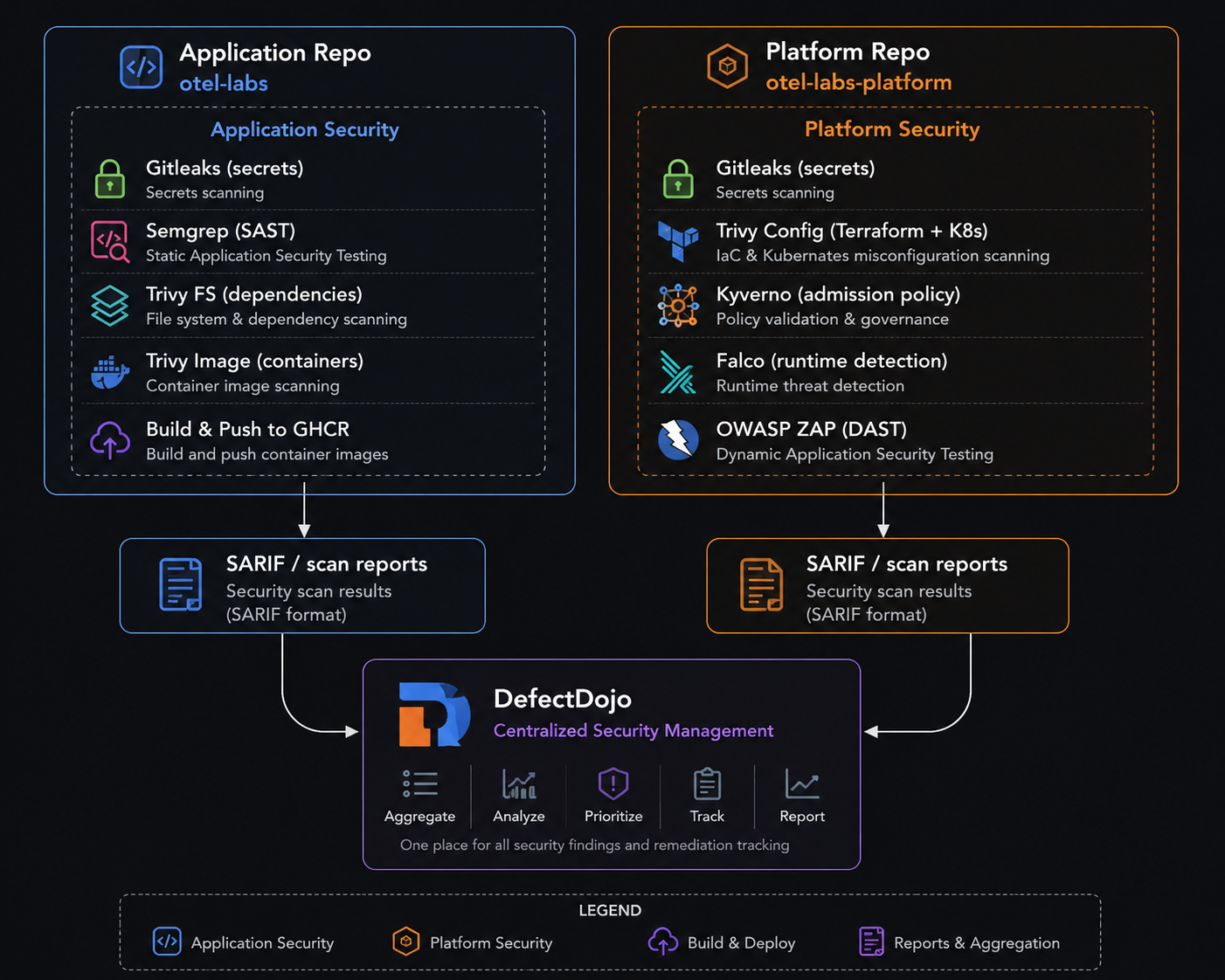
Scanning & Detection
Repositories
Application Repository: ◉ otel-labs
- Source code for Node.js, Python, and Go services
- Application security scanning (Gitleaks, Semgrep, Trivy)
- Container image builds and publishing to GHCR
Platform Repository: ◉ otel-labs-platform
- Terraform infrastructure (EKS, VPC, networking)
- Kubernetes manifests and ArgoCD applications
- Kyverno security policies and exceptions
- Infrastructure and configuration scanning
- OWASP ZAP DAST configuration
Components
Application Layer Security
| Tool | Purpose |
|---|---|
| Gitleaks | Secret detection in code and Git history |
| Semgrep | SAST — insecure coding patterns |
| Dependabot | Automated dependency updates |
Artifact & Infrastructure Layer
| Tool | Purpose |
|---|---|
| Trivy FS | SCA — dependency vulnerability scanning |
| Trivy Image | Container image vulnerability scanning |
| Trivy Config | Terraform and Kubernetes configuration scanning |
Kubernetes & Runtime Layer
| Tool | Purpose |
|---|---|
| Kyverno | Admission control and security policy enforcement |
| Falco | Runtime behavior detection and alerting |
| OWASP ZAP | Dynamic application security testing |
Findings Management
| Tool | Purpose |
|---|---|
| GitHub Security | Centralized SARIF findings in GitHub |
| DefectDojo | Centralized vulnerability management across all scanners |
Key Features
✅ Application Security — Gitleaks, Semgrep, Trivy scanning across multiple languages (Node.js, Python, Go)
✅ Infrastructure as Code Scanning — Terraform and Kubernetes manifest validation
✅ Kubernetes Admission Control — Kyverno policies enforcing image tags, resource limits, trusted registries
✅ Policy Exceptions — Scoped exceptions for legitimate platform workloads
✅ Runtime Security — Falco detecting suspicious process execution and file access
✅ Dynamic Testing — OWASP ZAP scanning deployed applications
✅ Centralized Findings — DefectDojo aggregating results from all security tools
✅ GitOps Integration — Security scanning triggered by GitHub Actions, results fed to DefectDojo
Workflow
Deployment
Prerequisites
- AWS account with EKS permissions
- kubectl configured
- GitHub repositories set up
- DefectDojo instance (local or cloud)
Bootstrap
Provision the infrastructure:
cd terraform
terraform init
terraform plan
terraform apply
The bootstrap script automatically installs:
- ArgoCD
- Kyverno
- Falco
Configure Security Workflows
Set GitHub Actions secrets in both repositories:
DEFECTDOJO_URL
DEFECTDOJO_API_KEY
Deploy Applications
Applications deploy via ArgoCD using the GitOps pattern:
kubectl apply -f k8s/argo-apps/root-app.yml
Or individually:
kubectl apply -f k8s/argo-apps/kyverno-policy.yml
kubectl apply -f k8s/argo-apps/traefik-app.yml
kubectl apply -f k8s/argo-apps/node-frontend-app.yml
# ... etc
End-to-End Flow
Blog Post
For a detailed walkthrough of the complete implementation, architecture decisions, and hands-on examples, see:
End-to-End DevSecOps on EKS: Code, Containers, Kubernetes & Runtime Security
The blog covers:
- Application security scanning (Gitleaks, Semgrep, Trivy)
- Infrastructure scanning (Trivy Config)
- Kyverno concepts and policy enforcement
- Falco runtime detection with practical examples
- OWASP ZAP dynamic testing
- DefectDojo centralized findings management
- End-to-end deployment and setup
Implementation Status
Completed
- ✅ Gitleaks secret scanning (application + platform repos)
- ✅ Semgrep SAST analysis
- ✅ Dependabot dependency updates
- ✅ Trivy filesystem scanning (SCA)
- ✅ Trivy container image scanning
- ✅ Trivy configuration scanning (Terraform + Kubernetes)
- ✅ GitHub Security integration (SARIF uploads)
- ✅ DefectDojo centralized findings management
- ✅ Kyverno admission policies (image tags, resource limits, trusted registries)
- ✅ Kyverno policy exceptions (scoped exemptions)
- ✅ Falco runtime security with FalcoSidekick
- ✅ OWASP ZAP DAST integration
- ✅ End-to-end workflow validation
- ✅ Comprehensive blog documentation
Related Projects
Infrastructure foundation and observability setup: OTel on EKS